Whisk 310b7a1e5c52427a6a44f86b53a49fbbdr

A Poetry Book About Love Loss and Healing Written From the Inside of All Three

Most poetry collections about love and loss are written looking backward. The poet has arrived somewhere safer, somewhere with enough distance to shape the experience into something composed and considered. The pain is real but it has been processed. It has been given form.
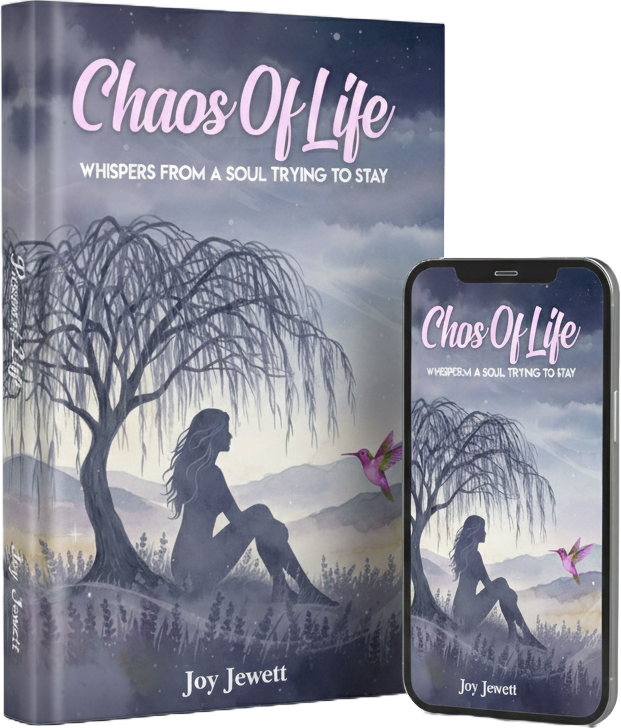
Joy Jewett had not arrived anywhere safe when she wrote Poetry, Chaos of Life. She wrote it in sixty days, from inside a life that was still happening to her, still unresolved, still raw, still asking questions she did not have answers to.
That is what makes this collection land differently from most poetry books about love, loss and healing. The healing is not complete. The loss is not historical. The love is not something she has finished wanting. She is a woman in her seventies who lost her husband of thirty-six years, discovered afterward that the financial life they built together had vanished with him, survived two rounds of cancer, had her heart weakened by Covid, and is still, still, writing poems addressed to a man who may or may not see her the way she sees him
She is not writing from the other side of her pain. She is writing from the middle of it, with the discipline of someone who knows that language is the only tool she has left that reliably works.
The result is a poetry book about love, loss and healing that does not promise healing as an endpoint. It offers something more honest than that, the company of a woman who keeps writing anyway, on the days when that is the most courageous thing available to her.
Whisk d791e8d09ac646b99104d6d057ddd6d2dr

The Poems About Loss That Will Stop You Mid-Page

Joy Jewett does not write about grief the way grief is usually written about in poetry. She does not wrap it in metaphor or keep it at a careful remove. She writes it the way it actually feels, as a thing that changes the shape of everything around it, including the shape of the person doing the grieving.
You Died and I’m No Longer Me is addressed to Bill, her husband of thirty-six years. The title says everything about what the poem does, not just the loss of a person but the loss of the self that existed inside the relationship with that person. When Bill died, Joy lost him and she lost the version of herself that had been built across three and a half decades of shared life. The money gone. The house gone. The future gone. All of it arriving at once, in the silence after.
Before Our Time Was Through, also for Bill, carries the particular ache of love that did not get to finish. Not a relationship that fell apart but one that was cut short by something neither of them chose.
Then there is In the New Morning Light, which maps Joy’s entire emotional history in one poem. First love at twenty. His death at twenty-five. Nine years alone. Then Bill. Then thirty-six years. Then loss again. Cancer twice. Covid. And at the end of all of it, one question she asks the ceiling while sleep will not come: Where will I be in the new morning light?
She does not answer it. She goes to sleep instead, or tries to. That is what grief actually looks like, not resolution, just the next morning arriving whether you are ready for it or not.
Whisk fced40d527321759ce044421af0b57bbdr

The Emotional Poetry Collection About Life Struggles That Does Not Simplify Them

There is a version of emotional poetry that packages struggle into something manageable. The arc is reliable, pain, reflection, growth, arrival. The reader finishes the collection feeling that the poet has, on their behalf, made sense of something difficult.
Poetry, Chaos of Life does not do that. Joy Jewett’s life struggles are not resolved by the act of writing about them. She writes I’m Not Depressed, I’m Just Tired and means it in the specific way that exhaustion, over a long enough period, becomes its own condition, not clinical, not dramatic, just the accumulated weight of too much loss and not enough replenishment. She writes I Have Nothing Left and it does not read as performance. It reads as an honest account of where she was on the day she wrote it.
She also writes about things that emotional poetry collections rarely touch, the specific humiliation of being scammed on a dating site by someone who constructed an entire false identity to take money from lonely women. Blackmailer, You Stole My Picture but Not My Life is not a victimhood poem. It is an assertion, made directly and with considerable force, that her life belongs to her regardless of what someone else tried to take from it. Scammed by Silence traces the slow realisation of what was happening and what it cost.
These are life struggles that belong to the present moment, to the particular vulnerabilities of women alone in their seventies navigating a world that has invented new methods of exploitation. Joy Jewett writes about them because they happened to her and because she believes they are worth writing about. She is right on both counts.
Whisk feb4ee7dc2b7c25b5c44f819955b14d7dr

The Love Poems: What Joy Jewett Still Believes In

Given everything this collection contains, the loss, the betrayal, the exhaustion, the unanswered prayers, it would be reasonable to expect the love poems to be elegies. Tender but past tense. Addressed to what was rather than what might still be.
They are not. Or not only.
Joy Jewett is still looking. Still hoping. Still writing poems addressed to a man she calls JGP throughout the collection, a presence that runs like a thread through the whole book, sometimes tender, sometimes frustrated, always unresolved. Just Us, A Hummingbird Dies for JGP, The Angry Man from Sweden, these are poems written to a real person about a real connection that has not found its form yet and may not. She knows that. She writes it anyway.
Dancing in Your Arms carries the particular warmth of love imagined rather than remembered, a woman dancing in the setting sun with the sea in the background, leaning into an arm that holds her. You Set Me Aflame reaches for the intensity that loss has not taken from her. A Letter of Lust and Love, My Dearest is exactly what its title says.
Joy Jewett at seventy-something still wants what she wanted at twenty. Not the same things in the same way, the poems are too honest for that, but the essential thing underneath them. To be seen. To be chosen. To be loved by someone who means it.
That she keeps writing about it, keeps reaching for it, after everything she has been through, is the most affecting thing in the collection.
Whisk fced40d527321759ce044421af0b57bbdr

The Poems That Will Make You Think Differently About Getting Older

There is a particular silence in mainstream culture around what it feels like to be a woman in her seventies who is still fully alive inside, still curious, still wanting, still furious when things are unjust, still moved by a cardinal in a winter window or a field of lavender or a mountain river where children are chasing fish with their bare hands.
Joy Jewett breaks that silence in almost every poem she writes.
The Walk in Fashion opens the collection with a woman who walked runways in her youth and never lost the knowledge of what it felt like to inhabit a room completely. She beat cancer not once but twice. She stood again after Covid. She is not chasing what passed, she is clear about that, but she is not pretending it did not exist either. She is chapter two, as she puts it. A bold advance.
What Is My Beauty? asks the question directly, not rhetorically, but genuinely, from the position of a woman watching beauty be defined around her in terms that exclude her and refusing to accept those terms as final. Why Can’t It Be Me? sits beside it with the same refusal to be written off.
Pisces Woman, Mystic and Strong is a self-portrait that does not apologise for a single element of itself. It is one of the most confident poems in the collection from a woman who, elsewhere in the same book, describes herself as fading.
That contradiction, between confidence and collapse, between I am still here and I have nothing left, is not inconsistency. It is what actually living in a human body, at any age, feels like. Joy Jewett just writes it down instead of tidying it up.

"Buy Now on Amazon"

Joy Jewett wrote Poetry, Chaos of Life because she needed to, because the words were there and because the only thing worse than writing them would have been not writing them. The collection covers love and its loss, grief and its aftermath, faith and its questions, the body and what it survives, and the particular courage of still wanting things when the world has given you every reason to stop.
It is available now on Amazon.
Read it slowly. Some of it will make you smile. Some of it will sit with you for days. All of it is true.
Book cover e-book format

Quote by Joy Jewett

“In the midst of chaos, love and hope find their quiet way into the heart”
AZ21HPtOM3aRi9bmP1NhpA AZ21HPtOb CKP0i36wxzZQ